
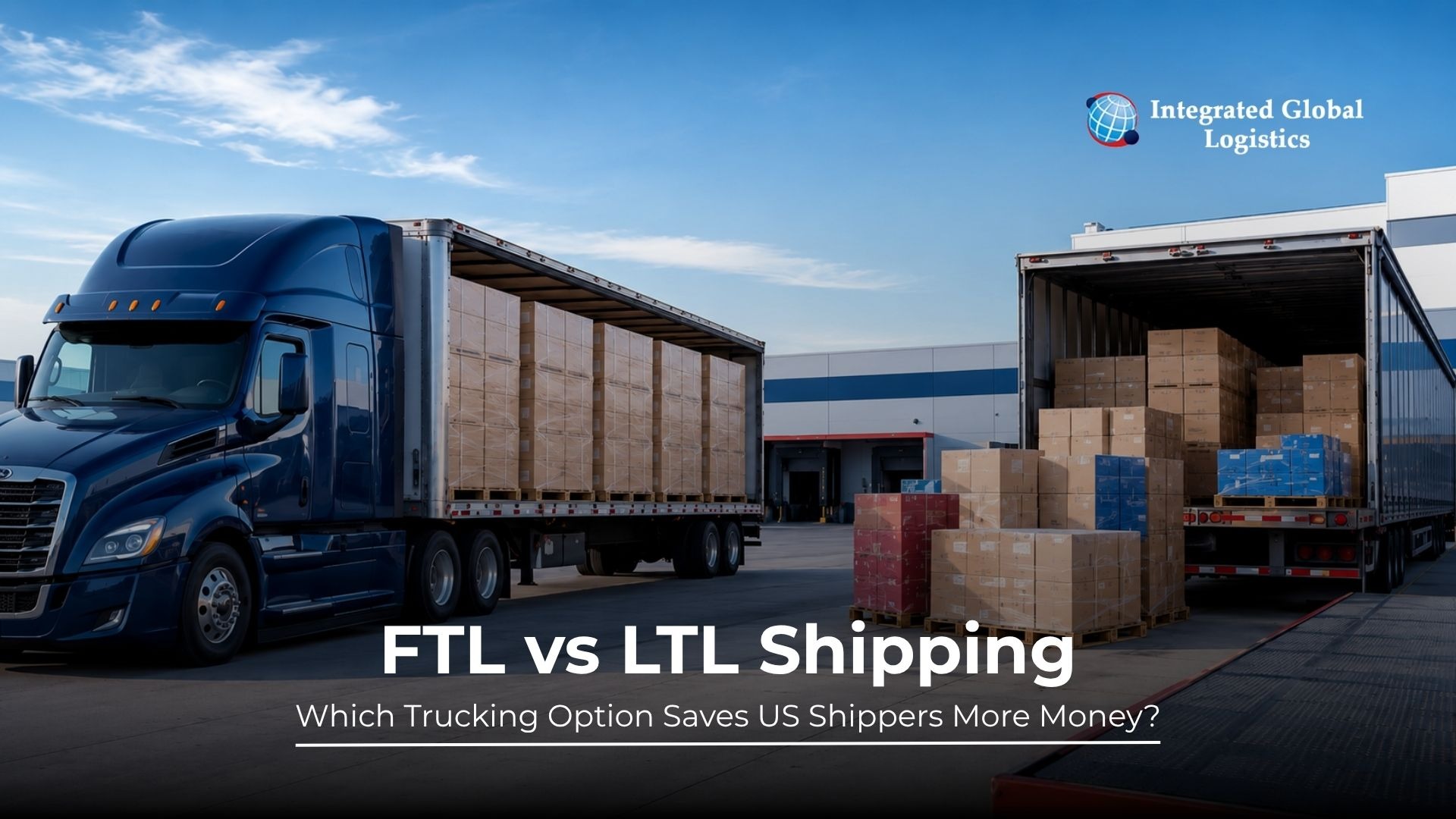
Full truckload (FTL) shipping dedicates an entire trailer to one shipper's cargo and moves it directly from origin to destination. Less-than-truckload (LTL) shipping consolidates multiple shippers' freight in one trailer and charges by weight and freight class. FTL becomes cost-competitive with LTL at approximately 10,000 to 15,000 pounds or 12 to 14 pallets, and often sooner when accessorial charges, damage exposure, and transit variability are factored into the total. For temperature-sensitive cargo, time-sensitive shipments, and high-volume lanes with consistent volumes, FTL typically delivers a lower total landed cost than LTL despite a higher base rate. LTL is genuinely more practical for small, occasional, non-urgent shipments that cannot justify a dedicated trailer. The decision is not a flat rate comparison. It is a total cost calculation.
The FTL versus LTL question comes up at every freight procurement discussion. On the surface, it appears straightforward: LTL charges by the pallet or the hundredweight, FTL charges by the load, so smaller shipments go LTL and larger ones go FTL. In practice, the line between cost-effective and cost-inefficient is not drawn at a weight threshold. It shifts based on freight class, lane, accessorial exposure, cargo sensitivity, and how precisely the total landed cost is measured.
Many shippers default to LTL for any shipment that does not fill a full trailer and discover the real cost only after the accessorial charges, reclassification fees, and damage claims arrive. Others default to FTL out of habit and overpay on lanes where LTL would genuinely be more efficient. Neither approach is wrong in principle. Both become expensive when applied without evaluating the full cost picture.
This guide breaks down how FTL and LTL are priced, where each mode is genuinely more cost-effective, and the specific cargo and operational conditions where FTL consistently outperforms LTL on total landed cost despite a higher upfront rate.
What Is FTL Shipping?
Full truckload (FTL) shipping is a domestic trucking mode where a single shipper's cargo occupies an entire trailer. The shipper pays for the full trailer regardless of whether the cargo fills it completely. The vehicle moves directly from the pickup location to the delivery destination without stopping to load or unload other shippers' freight along the way.
A standard FTL movement uses a 48-foot or 53-foot trailer, which can be a dry van for general cargo, a refrigerated trailer (reefer) for temperature-sensitive goods, a flatbed for oversized or open cargo, or a specialized unit for hazardous materials. The shipper controls the equipment, the loading, the departure timing, and the delivery appointment without sharing any of those variables with another shipper.
FTL pricing is negotiated per load or per mile on a lane basis. Because the rate applies to the full trailer regardless of weight up to the legal maximum, FTL becomes more cost-efficient on a per-pound or per-unit basis as shipment volume increases. The direct routing also eliminates the handling touchpoints, terminal dwell time, and delivery window variability that are structural features of LTL networks.
Standard conditions that indicate FTL is the right mode:
- Shipment weight above 10,000 to 15,000 pounds where per-pound FTL cost approaches or beats LTL rates
- 12 to 14 or more standard pallets that fill a meaningful portion of a 53-foot trailer
- Cargo requiring temperature control throughout transit, including refrigerated and frozen goods
- Time-sensitive freight where LTL transit variability creates downstream risk
- High-value or fragile goods where multiple handling events create unacceptable damage exposure
- Hazardous materials with co-loading restrictions that make LTL consolidation operationally restricted
What Is LTL Shipping?
Less-than-truckload (LTL) shipping consolidates cargo from multiple shippers into a single trailer. Each shipper pays only for the portion of the trailer their freight physically occupies. LTL carriers operate hub-and-spoke terminal networks where freight is picked up at origin, loaded into a trailer with other shippers' goods, routed through one or more break-bulk facilities, and then delivered from the destination terminal to the final address.
LTL pricing is based on freight class, a classification system governed by the National Motor Freight Classification (NMFC) that assigns a class number from 50 to 500 based on four factors: density, stowability, handling complexity, and liability. Higher freight classes carry higher per-hundredweight rates. Because freight class affects the final rate significantly, and because carriers can reclassify shipments at any terminal if the declared class does not match the measured density, LTL pricing carries more variability than the initial quote suggests.
LTL shipments pass through multiple handling events between origin and delivery. A typical movement involves pickup at origin, loading at the origin terminal, sorting at one or more break-bulk facilities, arrival at the destination terminal, and final delivery from that terminal to the consignee. Each event is a touchpoint where the shipment is loaded, unloaded, and repositioned.
Standard conditions where LTL is a practical choice:
- Shipments of one to six pallets or under approximately 5,000 pounds on a one-time or infrequent basis
- Non-urgent cargo where a multi-day transit window and variable delivery timing are acceptable
- Low-value, durable goods with minimal damage sensitivity where the handling frequency is not a risk factor
- Ad hoc or irregular shipments where a dedicated trailer cannot be justified by frequency or volume
FTL vs LTL: Key Differences at a Glance
| Factor | FTL (Full Truckload) | LTL (Less Than Truckload) |
|---|---|---|
| Trailer Use | Dedicated: one shipper, one trailer | Shared: multiple shippers consolidated in one trailer |
| Pricing Basis | Per load or per mile, negotiated by lane | Per hundredweight (cwt) based on freight class, weight, and distance |
| Routing | Direct: origin to destination, no intermediate stops | Hub-and-spoke: origin terminal, break-bulk, destination terminal |
| Cargo Handling Events | 2: load at origin, unload at destination | 3 to 7: multiple loading and unloading events across terminals |
| Transit Time | Faster, more predictable: direct lane timing | Longer, more variable: depends on terminal network and sort routing |
| Damage Exposure | Lower: cargo handled twice total | Higher: each handling event is an additional damage risk point |
| Temperature Control | Full and continuous: reefer trailer maintains set-point from pickup to delivery | Limited: mixed cargo, terminal dwell, and door openings create excursion risk |
| Accessorial Fee Exposure | Low: rate is typically all-inclusive per load | High: liftgate, residential, reclassification, appointment, and fuel surcharges add to base |
| Freight Class Required | No: FTL pricing does not depend on NMFC freight class | Yes: class must be declared and is subject to reclassification by the carrier |
| Best Fit | 12+ pallets, consistent volume, temperature-sensitive, time-sensitive, high-value, or port-connected cargo | 1 to 6 pallets, infrequent, non-urgent, durable, lower-value cargo |
When FTL Costs Less Than LTL: The Real Break-Even Point
The assumption that LTL is always less expensive than FTL for shipments that do not fill a trailer is one of the most consistently expensive assumptions in US freight procurement. It is not wrong in every case, but it fails to account for how LTL pricing actually accumulates from quote to final invoice.
The base LTL rate, the number that appears on a carrier quote, is the starting point. It is priced on freight class and hundredweight. What follows is where the gap between quote and final cost opens: accessorial charges, fuel surcharges calculated as a percentage of the base rate, reclassification adjustments if a carrier remeasures the shipment at a terminal, and any service-specific fees tied to the delivery location or appointment requirements. A shipment quoted at one rate frequently arrives at invoice with 15 to 35 percent added from line items that were not visible at the time of booking.
FTL pricing is structured differently. The per-load rate is negotiated on the lane, and with a reliable FTL carrier, that rate is the rate. There is no freight class, no reclassification risk, and typically no per-shipment accessorial exposure beyond standard fuel surcharges. What a shipper sees on an FTL quote is close to what appears on the invoice.
The volume threshold where FTL becomes genuinely competitive with LTL on a total-cost basis is approximately 10,000 to 15,000 pounds or 12 to 14 pallets on a standard 53-foot trailer. But that threshold is not fixed. It shifts based on several variables:
- Freight class: Higher-class freight, such as class 85 to 150, carries substantially higher per-hundredweight LTL rates. FTL does not use freight class at all, which means high-class cargo reaches the FTL cost parity point at lower volumes than dense, low-class freight.
- Lane density: On high-volume lanes where LTL carriers have strong terminal coverage and full trailers routing regularly, LTL base rates are more competitive. On thinner lanes with less terminal density, LTL pricing climbs and the FTL advantage arrives at lower volumes.
- Accessorial exposure: A shipment requiring liftgate pickup, liftgate delivery, and a delivery appointment adds fixed accessorial charges to every movement. A shipper making that same move weekly accumulates those charges quickly. A single FTL rate for the same lane does not.
- Transit requirements: If a delivery must land within a two-day window and LTL transit variability regularly creates three-day-plus deliveries, the cost of missed delivery is downstream: production delays, inventory re-planning, expedited re-shipment. Those costs rarely appear on a freight invoice, but they belong in the total cost comparison.
For shippers managing domestic trucking as part of a broader international freight program connecting multiple countries and trade lanes, the cost and timeline accuracy of the US domestic trucking leg directly affects the performance of the entire supply chain. An LTL delay that extends domestic transit by two days can cascade into a missed ocean freight cutoff, a rolled booking, and a two-week shipping delay to the destination market.
When LTL Is the More Practical Option
LTL is a well-functioning, cost-effective mode for the shipments it is designed to serve. The cases where it genuinely makes the most financial sense share a few consistent characteristics.
- Low volume, infrequent shipments: A shipper moving two or three pallets of durable goods across state lines on a monthly or quarterly basis will pay more for a dedicated trailer than the cargo justifies. LTL is the right tool for this use case.
- Non-urgent, low-value cargo: When delivery timing flexibility is available and the goods are not sensitive to handling or temperature, LTL's per-hundredweight pricing is straightforward and generally lower for small volumes.
- Testing a new lane before committing to FTL volume: Shippers evaluating a new distribution lane can use LTL to establish demand before the volume justifies a contracted FTL rate negotiation.
- Overflow or surge volume above regular FTL capacity: When a shipper's regular FTL volume is already contracted and a small overflow shipment needs to move on the same lane, LTL handles the incremental volume without requiring an additional full trailer booking.
The decision criterion is straightforward: if the cargo is small, durable, non-urgent, and does not require continuous temperature control or tight transit windows, LTL is a practical and cost-appropriate choice. When any of those conditions change, the cost comparison shifts and FTL should be re-evaluated.
Temperature-Sensitive Cargo: Why FTL Is the Operating Standard in Cold Chain Trucking
The FTL versus LTL cost comparison changes fundamentally for temperature-sensitive cargo. For refrigerated goods, pharmaceuticals, fresh produce, frozen protein, and any freight that requires a controlled environment throughout transit, the calculation is not primarily about rate. It is about cargo integrity, regulatory compliance, and chain of custody documentation.
In a refrigerated FTL movement, the trailer is pre-cooled to the required set-point before loading begins. Once loaded and sealed, the cargo moves directly from origin to destination without any intermediate stops where the trailer door opens, the temperature environment changes, or the cargo is handled by a third party. The cold chain remains unbroken from the point of loading to the point of delivery.
LTL consolidation creates the opposite conditions. At each terminal, the trailer door opens. Cargo is handled alongside freight from other shippers at different temperature requirements. Dwell time at break-bulk facilities can extend to hours. The set-point of the reefer trailer must balance the needs of multiple consignments, which means no single shipper's cargo is guaranteed its exact required temperature profile throughout transit. For products where a temperature excursion of even a few hours affects shelf life, safety certification, or regulatory status, this is not an acceptable operating condition regardless of the rate difference.
Understanding the specific requirements of reefer truckload shipping, including pre-cooling procedures, set-point verification, trailer inspection standards, and continuous monitoring documentation, determines whether a cold chain shipper can actually protect its cargo integrity and meet the compliance standards that govern food, pharmaceutical, and perishable exports from the United States.
For US food exporters evaluating cold chain logistics providers for perishable export programs, the trucking component is often where the cold chain either holds or breaks. A provider with dedicated reefer FTL capability, GPS temperature monitoring from pickup to port, and the food export credentials to support USDA and FDA compliance documentation at every stage of the move delivers a materially different level of cargo protection than one managing the domestic leg as a secondary service.
Integrated Global Logistics operates dedicated reefer FTL across all 48 contiguous states, with refrigerated trucking structured specifically to connect US domestic cold chain movements to ocean freight export operations. IGL holds USMEF (US Meat Export Federation) and USAPEEC (USA Poultry and Egg Export Council) certifications, which position its cold chain trucking within a broader food export compliance framework that covers the full domestic-to-port movement, not just the trucking leg in isolation.
FTL as the First or Final Mile in an Ocean Freight Supply Chain
For US exporters and importers managing international cargo, domestic FTL is rarely an independent decision. It is the trucking leg that connects a warehouse, production facility, or distribution center to a port terminal, or that completes the movement from a port terminal to the final destination after an ocean voyage. When that trucking leg is misaligned with the ocean freight timeline, the entire export or import operation absorbs the cost.
On the export side, an FTL movement from origin to port must clear the facility and arrive at the port terminal before the vessel's cargo cutoff. A delayed truck means a rolled booking. A rolled booking on a weekly service means the cargo waits seven days for the next available vessel. On the import side, a delayed or misrouted FTL drayage from the port means demurrage and detention charges accumulate on the container sitting in the terminal yard while the delivery is rescheduled.
For shippers who route ocean containers through Port Newark or Port Everglades on the US East Coast, FTL coordination with the port is not a secondary concern. It is the operational variable that determines whether the export booking actually sails and whether the import container moves out of the port within the free time window. An FTL provider with direct port relationships and experience coordinating truck appointments, container pickups, and cargo cutoff timing at these terminals creates significantly more reliable export execution than a provider managing trucking as a separate, unconnected service.
For shippers understanding whether an NVOCC or freight forwarder is arranging their ocean freight, the type of intermediary directly affects how tightly the FTL trucking leg gets coordinated. A provider that issues its own House Bill of Lading as a licensed NVOCC and manages the FTL leg under the same operational umbrella can align truck dispatch, container availability, port appointment, and documentation on a single workflow. When the ocean and trucking legs are managed by separate parties with separate systems and separate accountability, those handoff points become the most common source of missed cutoffs, documentation gaps, and avoidable detention charges.
Integrated Global Logistics manages ocean freight and FTL trucking as a connected operation. For US exporters routing cargo through East Coast ports, IGL coordinates the FTL pickup, port delivery timing, container planning, and export documentation as a single managed workflow, reducing the handoff gaps that consistently drive export delays in separately sourced logistics arrangements.
Frequently Asked Questions
What is the difference between FTL and LTL shipping?
FTL (Full Truckload) shipping dedicates an entire trailer to a single shipper's cargo and moves it directly from origin to destination without intermediate stops. LTL (Less Than Truckload) shipping consolidates multiple shippers' freight in one trailer, with each shipper paying only for the space their cargo occupies. The key differences are pricing structure (per load vs per hundredweight and freight class), transit speed (direct vs terminal network routing), cargo handling frequency (two touchpoints for FTL vs three to seven for LTL), and damage exposure. FTL provides a single, uninterrupted movement. LTL involves multiple loading, sorting, and unloading stages between origin and delivery.
At what shipment size does FTL become more cost-effective than LTL?
FTL typically becomes cost-competitive with LTL at approximately 10,000 to 15,000 pounds or when a shipment fills 12 to 14 or more standard pallets on a 53-foot trailer. At this volume, the LTL per-hundredweight rate and freight class charges, combined with accessorial fees, often reach or exceed the all-in FTL rate for the same lane and cargo. The tipping point is not fixed: it shifts based on freight class, lane density, distance, and how many accessorial charges apply to the LTL shipment. Time-sensitive and temperature-sensitive shipments often reach the FTL cost threshold at lower volumes because of the additional operational and financial value of direct, uninterrupted transit.
What are the most common hidden costs in LTL shipping?
The most common hidden costs in LTL shipping include: accessorial charges such as liftgate pickup and delivery fees, residential delivery surcharges, limited access location surcharges, and inside delivery fees; freight class reclassification charges when a carrier remeasures or reweighs a shipment and upgrades the class at origin or destination terminal; fuel surcharges applied per hundredweight, which compound as the base rate increases; delivery appointment fees; and excess length or oversize surcharges. Beyond line-item charges, LTL carries an indirect cost in transit variability: shipments routed through multiple terminals typically have wider delivery windows than FTL, and missed windows create downstream inventory and production costs that rarely appear on the freight invoice.
Is FTL or LTL better for temperature-sensitive cargo?
FTL is the standard for temperature-sensitive cargo and is strongly preferred for any shipment requiring continuous refrigeration. In an FTL reefer movement, the trailer is pre-cooled, temperature-set before loading, and runs without intermediate stops or mixed-cargo dwell time. This maintains an unbroken cold chain from pickup to delivery. LTL consolidation of refrigerated cargo introduces temperature risk at each terminal stop: dwell time, door opening during sort, and co-mingling with cargo requiring different temperature ranges all create excursion risk. For perishable food products, pharmaceuticals, and other regulated temperature-sensitive goods, FTL reefer is not just operationally preferable. It is frequently required to maintain regulatory compliance and cargo integrity documentation.
How does FTL transit time compare to LTL?
FTL transit times are typically faster and more predictable than LTL on the same lane. Because FTL moves direct from origin to destination without terminal stops or consolidation routing, a shipment that takes two transit days as FTL may take three to five days or more through LTL terminal networks. More importantly, LTL transit windows carry more variability: terminal congestion, sort delays, and carrier network routing decisions can extend delivery beyond the standard estimate. FTL departure and delivery windows are generally tighter and more reliable, which matters significantly for just-in-time production schedules, port cutoff coordination, and perishable cargo with a narrow delivery window.
What types of cargo should always be shipped FTL?
Cargo that should consistently ship FTL includes: temperature-sensitive goods such as food products, fresh produce, frozen meat, and pharmaceuticals requiring refrigerated transit; high-value cargo where damage exposure from multiple handling events outweighs any base rate savings from LTL consolidation; hazardous materials that carry strict handling and co-loading restrictions; oversized or heavy freight that exceeds LTL carrier dimensional limits; time-sensitive shipments where the LTL transit window creates downstream supply chain risk; and high-volume shipments of 10,000 pounds or more where FTL pricing is competitive on a total-cost basis. Cargo destined for port loading or originating from a port on a tight export cutoff schedule also benefits from FTL because of the tighter transit window and more reliable arrival timing.
How does FTL trucking connect to ocean freight shipments?
FTL is frequently the first or final mile of an ocean freight supply chain. For US exporters, an FTL movement from a warehouse or production facility to a port terminal connects the domestic leg to the ocean leg of the shipment. For US importers, an FTL drayage movement from the port terminal to a warehouse or distribution center completes the import side. When an FTL provider also manages the ocean freight, the coordination between trucking and vessel cutoff, container availability, port appointment, and documentation timing becomes significantly more controlled. The alternative is managing the two legs through separate providers, which creates handoff gaps that frequently result in missed cutoffs, documentation misalignment, or cargo arriving at the port after the vessel has departed.
FTL Trucking Structured Around Your Supply Chain
Integrated Global Logistics provides full truckload shipping across all 48 contiguous states, with dedicated reefer FTL for temperature-sensitive cargo and direct port coordination for export and import movements through US East Coast terminals. IGL's FTL services are built around commercial shippers with recurring lane volume, cold chain requirements, or trucking legs connected to ocean freight export programs.
If your operation requires FTL on a domestic lane, an export-connected reefer move, or port drayage coordination through New Jersey or Florida, our freight team can assess routing, equipment, and supply chain integration requirements.
Speak With an IGL Freight Specialist