
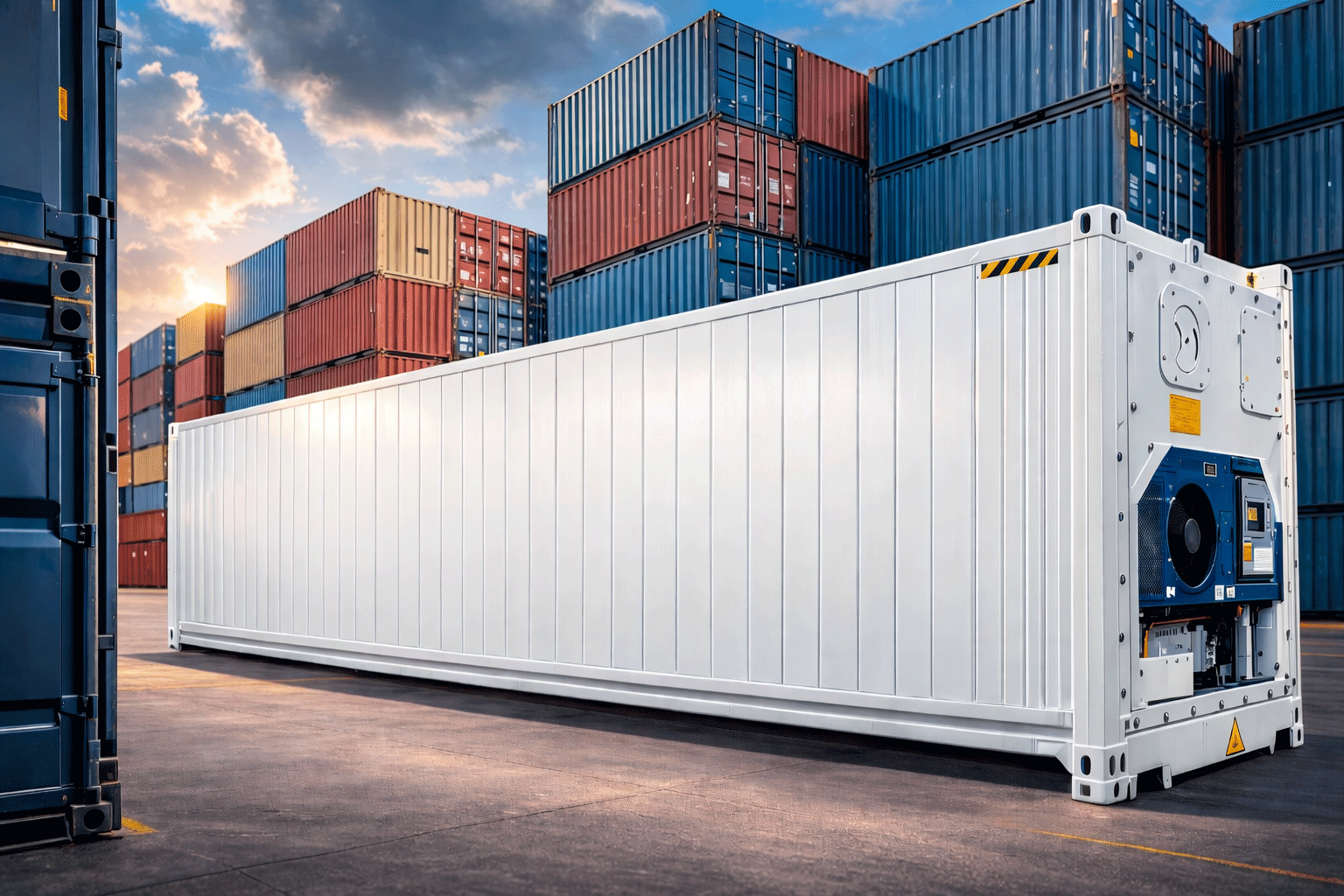
What Is a Reefer Container?
A reefer container is a refrigerated intermodal shipping container with an integrated mechanical refrigeration unit. The unit actively maintains a precise internal temperature throughout ocean transit, port storage, and inland transport, regardless of external ambient conditions. Modern reefer containers can hold temperatures from approximately -30 degrees Celsius for deep-frozen cargo up to +30 degrees Celsius for cargo that requires mild temperature protection.
The refrigeration system in a reefer container operates by drawing power from the vessel during ocean transit ("vessel slots"), from diesel generator sets during trucking or storage, or from shore-power connections at ports and cold storage facilities. This power requirement is one of the core operational factors that distinguishes reefer container logistics from dry freight. Equipment without a confirmed power source is not a cold chain. It is a cooling unit waiting to fail.
Every reefer container is also equipped with a data logger that records the internal temperature at regular intervals, typically every 15 minutes, throughout the shipment. This log is the primary verification tool for cold chain compliance. It is reviewed at destination to confirm that the cargo held within the agreed temperature range throughout transit, and it is the central document in any temperature-related cargo claim.
This is the single most important principle in reefer container shipping. The refrigeration unit is designed to hold a pre-set temperature, not to reduce the temperature of warm cargo. Cargo that is not already at the required temperature before loading will raise the container's internal temperature, and the unit cannot compensate fast enough to prevent an excursion. Every piece of freight must arrive at the stuffing point already chilled or frozen to specification.
Container Types, Sizes, and When to Use Each
Selecting the wrong container type is a booking error that surfaces at the loading point, when the commodity's requirements cannot be met by the equipment that has been arranged. Understanding the available container types and their operational differences is a prerequisite to booking any reefer shipment.
| Container Type | Internal Volume | Max Payload | Best For |
|---|---|---|---|
| 20ft Standard Reefer | ~28 CBM | ~21 MT | Frozen meat, pharma, smaller export volumes |
| 40ft Standard Reefer | ~60 CBM | ~27 MT | Large volume frozen or chilled food exports |
| 40ft High-Cube Reefer | ~67 CBM | ~27 MT | High-volume chilled produce, poultry, dairy |
| Controlled Atmosphere (CA) | 40ft / 45ft variants | Comparable to HC | Fresh apples, pears, avocados, berries |
| Super Freezer Reefer | 20ft / 40ft variants | Standard volumes | Bluefin tuna, select seafood (-50°C to -60°C) |
Controlled Atmosphere Containers
Controlled atmosphere containers extend beyond temperature management by actively regulating the gas composition inside the container. By reducing oxygen and elevating carbon dioxide, CA shipping slows the respiration rate of fresh produce and extends shelf life significantly on long ocean transits. This technology is particularly relevant for US fresh fruit exports heading to markets in Asia, the Middle East, and Europe, where transit times routinely exceed three weeks.
Not all shipping lines offer CA-capable equipment on all trade lanes, and availability is tighter than standard reefer equipment. Shippers planning CA shipments need to book early and work with a logistics provider that has established relationships with carriers operating CA-capable vessels on the relevant trade lane.
The 40ft High-Cube Reefer: The Default for US Food Exports
For the majority of US food and agricultural exports, the 40ft high-cube reefer is the operating standard. It provides the best per-unit cost economics for large shipments and is widely available at all major US export gateways, including Los Angeles and Long Beach, New York and New Jersey, Miami, Houston, and Charleston. The additional vertical clearance compared to a standard 40ft unit matters for palletized fresh produce where stack height is a factor in airflow management.
Temperature-Sensitive Commodities That Ship in Reefers
The range of cargo that requires refrigerated container shipping is broader than most shippers initially assume. Food and agricultural products account for the largest share of global reefer volume, but pharmaceutical cold chain and certain industrial cargo categories also move in significant volumes.
Frozen at -18°C or chilled at -1.5°C to 0°C. USDA export protocols apply. IGL holds USMEF certification for US meat export logistics.
Frozen poultry at -18°C. Shell eggs at +7°C to +10°C. IGL holds USAPEEC certification for US poultry and egg export logistics.
Chilled salmon and white fish at 0°C to +2°C. Frozen seafood at -18°C to -25°C. Super-frozen bluefin tuna requires specialty equipment.
Apples and pears at -1°C to +1°C. Avocados at +7°C to +13°C. Citrus at +5°C to +10°C. CA shipping strongly recommended for long-haul lanes.
Fluid milk at +2°C to +6°C. Cheese and processed dairy at +2°C to +8°C. Frozen butter at -18°C. Humidity management is important for aged cheeses.
Vaccines and biologics at +2°C to +8°C. GDP documentation and validated equipment required. Temperature excursions can void product efficacy.
Temperature Set Points by Commodity: Reference Guide
The following table provides indicative temperature set points for the most common reefer container commodities. These ranges represent standard operating parameters. Actual set points for any shipment must be confirmed with the shipper's food safety or quality team, the buyer's receiving specifications, and any applicable regulatory standards for the commodity and destination country.
| Commodity | Set Point | Humidity Setting | Ventilation | Key Risk |
|---|---|---|---|---|
| Frozen beef / pork / lamb | -18°C | 85-95% | Closed | Partial thaw above -12°C |
| Fresh chilled beef | -1.5°C to 0°C | 90-95% | Minimal | Freeze damage below -2°C |
| Frozen poultry | -18°C | 85-95% | Closed | USDA frozen standard violation above -12°C |
| Shell eggs | +7°C to +10°C | 70-85% | 25 CBM/hr | Freeze damage below +2°C |
| Fresh salmon / chilled seafood | 0°C to +2°C | 95-100% | Minimal | Short shelf life; each hour above range matters |
| Frozen seafood | -18°C to -25°C | 85-95% | Closed | Drip loss and texture damage on partial thaw |
| Fresh apples / pears | -1°C to +1°C | 90-95% | 15-25 CBM/hr | CA shipping preferred; chilling injury below -1.5°C |
| Avocados | +7°C to +13°C | 90-95% | 25-50 CBM/hr | Chilling injury below +7°C; ripening above +13°C |
| Citrus fruits | +5°C to +10°C | 85-95% | 25 CBM/hr | Chilling injury; ethylene-sensitive varieties vary |
| Dairy (butter frozen) | -18°C | 85% | Closed | Flavor absorption; packaging integrity |
| Pharmaceuticals (2-8°C) | +2°C to +8°C | Varies | Per GDP guidelines | Excursions may void efficacy; GDP validation required |
The temperature set point programmed into the reefer unit is not the same as the acceptable temperature range for the cargo. Set points are typically set a degree or two inside the acceptable range to create buffer against minor fluctuations. A cargo with an acceptable range of -15°C to -18°C would typically be set at -18°C, not at -15°C. Confirming both the set point and the acceptable range with the shipper before loading removes ambiguity at the point of delivery acceptance.
Pre-Trip Inspection and Pre-Cooling
The pre-trip inspection (PTI) is the quality gate before any reefer container is presented for loading. It verifies that the refrigeration unit is functioning correctly, that the container is structurally sound and clean, and that the data logger is active and recording. Skipping or rushing the PTI is the operational decision most consistently associated with cold chain failures in reefer container shipping.
The refrigeration unit is run to the required set-point temperature and its performance is verified. The unit must reach and hold the target temperature within the expected pull-down time. Any unit that cannot demonstrate stable temperature performance at the required set point before loading is presented fails the PTI and must be replaced or serviced before cargo is loaded.
The container interior is inspected for damage, contamination, foreign odors, and any compromise to the insulation or door seals. Damaged door gaskets are among the most common causes of temperature excursions in reefer containers, because a poor seal allows warm ambient air to enter the container continuously during transit. Any container with damaged seals must be rejected.
The onboard data logger is verified to be active, recording at the correct interval, and synchronized to the correct time zone. For shipments where independent temperature monitoring is used alongside the container's logger, both devices are verified and compared against each other before loading begins.
After the PTI is complete, the container must be pre-cooled to the required set-point temperature for a minimum of two to four hours before loading begins. The verification of pre-cooling must use the container's return air temperature sensor, not the supply air sensor, which will consistently read lower than the actual interior temperature and can create a false impression that the container has reached temperature when it has not.
PTI coordination and pre-cooling verification are standard steps in every reefer container booking IGL manages, not optional checkpoints that get skipped when schedules are tight. These are the operational foundation that the rest of the cold chain depends on, and shippers who want to understand how IGL structures the end-to-end process for temperature-controlled cargo from origin inspection through final delivery can see the full workflow broken down by stage.
Loading, Airflow, and Set-Point Configuration
Correct loading technique is as important as correct set-point configuration. A reefer container that is loaded incorrectly will develop hot spots and uneven temperature distribution even when the refrigeration unit is performing to specification. The following principles apply to all reefer container loading operations.
Load Only Pre-Conditioned Cargo
Every pallet or carton that enters the container must already be at the required temperature. Verify product temperatures with a calibrated probe thermometer at the point of loading, not at the point of production. Product that has been waiting in an ambient staging area while the container is being positioned at the loading dock may have already begun to warm. Any product that cannot be confirmed at the correct temperature must not be loaded.
Maintain T-Bar Floor Clearance
Reefer containers are designed with a T-bar floor that circulates chilled air from the front of the container along the floor and back up through the cargo from below. Pallets must be positioned to allow unobstructed airflow through the T-bar channels. Blocking floor channels with product, dunnage bags, or pallet boards restricts the primary airflow pathway and creates temperature gradients that no set-point adjustment can correct.
Do Not Block the Return Air Bulkhead
The return air bulkhead at the front of the container draws warm air from the cargo back through the refrigeration unit to be recirculated as chilled air. Stacking cargo against this bulkhead, even partially, reduces the unit's ability to recirculate air and forces the unit to work harder to maintain temperature. Most reefer containers specify a minimum 15 cm clearance from the front bulkhead in their loading instructions.
Ventilation Settings for Fresh Produce
Fresh produce respires continuously, releasing carbon dioxide and generating heat inside the container. Ventilation settings control the rate at which fresh outside air is introduced to manage CO2 buildup and ethylene concentration. Setting ventilation too high for frozen cargo wastes energy and introduces temperature variance. Setting it too low for fresh produce allows CO2 to accumulate and can accelerate spoilage. Ventilation must be confirmed against the specific commodity before the container is sealed.
Moving Temperature-Sensitive Cargo Internationally?
IGL is USMEF and USAPEEC certified with verified destination agents across 50+ countries. Our team manages the full reefer container process from PTI and pre-cooling through to final delivery documentation.
Transit Monitoring and Temperature Excursions
Once the container is sealed and dispatched, the cold chain depends on two things: the integrity of the equipment and the quality of the monitoring system watching it. Modern reefer containers support remote monitoring via satellite during ocean transit, which means temperature alerts can be received in real time, not discovered at destination after the damage has already occurred.
What Constitutes a Temperature Excursion
A temperature excursion is any deviation from the agreed set-point range that occurs during transit. Not every excursion is a catastrophic event. Minor, brief deviations caused by door openings at transshipment points may be within acceptable tolerance. Sustained deviations, or deviations that exceed the maximum acceptable temperature for the commodity even briefly, are a different matter and require immediate escalation.
The data logger provides the factual record of exactly when an excursion occurred, for how long, and by how much. This record is the primary evidence in any cargo claim discussion with the shipping line, insurer, or buyer. A shipper without a data logger record is arguing from memory. A shipper with a complete, timestamped data logger record is arguing from fact.
Response Protocol for In-Transit Excursions
When a temperature alarm is triggered during ocean transit, the response options depend on where the vessel is and what caused the excursion. If the refrigeration unit has failed, the carrier's technical team onboard may be able to repair it at sea. If the vessel is within range of a transshipment port, cargo may be able to be transhipped to a replacement container. If neither option is viable, the logistics provider must begin coordinating the commercial response with the shipper and the buyer before the vessel arrives at the discharge port.
IGL maintains 24/7 monitoring capability for all active reefer container shipments. When a temperature alert is triggered, the response is immediate, not scheduled for the next business day. Shippers who want to understand the four-stage process IGL applies from origin inspection through exception handling can review how IGL structures its cold chain monitoring and escalation workflows for temperature-controlled cargo.
Transshipment Hubs and Power Continuity
Transshipment at intermediate ports is one of the highest-risk periods in a reefer container's journey. During transshipment, the container is typically unloaded from one vessel, stored on the terminal, and loaded onto the connecting vessel. During terminal storage, the container must remain plugged into shore power. Power interruptions, even brief ones, create temperature drift that may not appear in the data log as a single clear excursion but accumulates across the transit as a pattern of mild but sustained temperature elevation.
Shippers using routes with transshipment stops should confirm with their logistics provider that shore power plug-in at the transshipment terminal is being actively tracked and that the carrier has arrangements for priority plug-in if power points are in demand. This operational detail is frequently overlooked by shippers focused only on the origin port and final destination.
Compliance and Documentation for US Reefer Exports
US reefer container exports operate under a compliance framework that is more demanding than most dry freight categories. The combination of FDA food safety requirements, USDA commodity-specific standards, and destination country import regulations creates a documentation set that must be complete and accurate before the vessel departs. Errors discovered at destination customs can result in cargo holds, rejections, or destruction orders that no amount of good temperature management can reverse.
Core Documentation for US Reefer Exports
- Commercial Invoice with accurate commodity description, HS code, country of origin, unit price, and buyer/seller details
- Packing List with detailed breakdown of cartons, gross and net weights, dimensions, and pallet count
- Bill of Lading (House and Master) issued by the NVOCC and shipping line
- Electronic Export Information (EEI) filed via AES for all US exports valued above $2,500 per Schedule B number
- Certificate of Origin required by most destination countries for tariff determination
- USDA Export Health Certificate required for all meat, poultry, and processed food exports destined for markets requiring official certification
- Phytosanitary Certificate required for fresh produce exports by virtually all destination countries
- FDA Prior Notice required for all food and beverage imports into the USA
Commodity-specific documentation requirements vary significantly by product type and destination market. For exporters building their first reefer container program or expanding to new trade lanes, the documentation requirements for a specific commodity and destination should be confirmed with a freight forwarder experienced in that trade lane before the first shipment is booked. Exporters who are newer to the full container load process and want to understand how an FCL booking is structured from the moment a quote is requested through to port cut-off and vessel departure will find the end-to-end workflow laid out alongside the reefer-specific requirements that apply at each stage.
FSMA Sanitary Transportation
The FDA's Food Safety Modernization Act Sanitary Transportation Rule applies to the domestic trucking leg of reefer shipments as well as to ocean freight. Carriers must maintain sanitation records, temperature control documentation, and driver training records. Shippers who use carriers that cannot produce these records on request assume regulatory risk in the event of a food safety inspection or enforcement action.
Working with a Licensed NVOCC
For reefer container ocean freight, the logistics provider's licensing status matters. An FMC-licensed NVOCC can issue its own House Bill of Lading, assume carrier liability for the cargo, and negotiate volume-based service contracts with shipping lines that provide access to reefer equipment on lanes where spot market availability is constrained. Shippers who work with unlicensed brokers or intermediaries do not have the same contractual protections and may find their claims options significantly limited in the event of cargo loss or damage.
IGL holds FMC NVOCC licensing and operates as a full-service international freight forwarder. Shippers who are unfamiliar with what that licensing status actually means for their cargo rights, their claims position, and their liability exposure when something goes wrong at sea will find the answer in IGL's breakdown of how NVOCC licensing works and why it changes what a shipper can do when freight is damaged or delayed.
Cold Chain Risks and How IGL Mitigates Them
Every reefer container shipment carries a defined set of operational risks. Understanding where the failure points are, and what specific mitigations address each one, is the difference between a cold chain that holds and one that requires a claims call after discharge.
Temperature excursion during ocean transit
24/7 remote monitoring with automated alerts and immediate escalation protocol. Defined response matrix for in-transit deviations.
Refrigeration unit failure before or during transit
Pre-trip inspection required before every booking is confirmed. Backup equipment coordination at key locations for domestic legs.
Power interruption at transshipment terminals
Priority plug-in arrangements with carriers and terminals. Active tracking of power status during transshipment dwell time.
Documentation errors causing customs delays
Standardized documentation checklists reviewed against destination requirements before cargo reaches the port. Pre-clearance verification where available.
Poor loading technique creating hot spots
Carrier vetting for loading discipline. Specific loading instructions provided to all stuffing locations covering airflow, floor clearance, and return air bulkhead requirements.
Vessel schedule disruptions extending transit time
Route selection that accounts for shelf life against transit time. Early notification of vessel delays and proactive communication with buyers about revised arrival estimates.
Shipping Reefer Containers from the USA?
IGL coordinates the full cold chain: domestic refrigerated trucking to the port, reefer container booking, documentation, transit monitoring, and destination delivery across 50+ countries. Talk to a specialist about your commodity and trade lane.
Connecting the Reefer Container to the Domestic Cold Chain
For US exporters, the reefer container is rarely the beginning of the cold chain. The cargo has typically traveled by refrigerated truck from a production facility, cold storage warehouse, or processing plant before it is stuffed into the ocean container at the port. The quality of that domestic leg is inseparable from the quality of the ocean leg. A product that arrives at the port stuffing point warm, partially thawed, or in poor condition cannot be rescued by the ocean container, no matter how well the reefer unit performs.
IGL manages both the domestic refrigerated trucking leg and the international ocean freight leg for exporters who need a single accountable partner across the full cold chain. The domestic leg has its own discipline around carrier qualification, PTI verification, and continuous-run mode configuration that is just as consequential as the ocean leg. Exporters who want to understand how qualified carriers are selected, loaded, and monitored for domestic refrigerated trucking will find the full process documented with the same operational depth as this guide. For exporters who already have the domestic leg under control and are ready to build the international side of the program, IGL has documented each stage of the international reefer container process from PTI and container stuffing through ocean transit, port clearance, and final cold delivery.
Integrated Global Logistics holds USMEF certification for US meat export logistics and USAPEEC certification for US poultry and egg export logistics. These certifications are not marketing designations. They reflect that IGL's operating procedures for meat and poultry exports meet the standards set by the US Meat Export Federation and the USA Poultry and Egg Export Council. For buyers in markets that require documented compliance with US export standards, IGL's certified status is a verifiable credential, not a claim.