
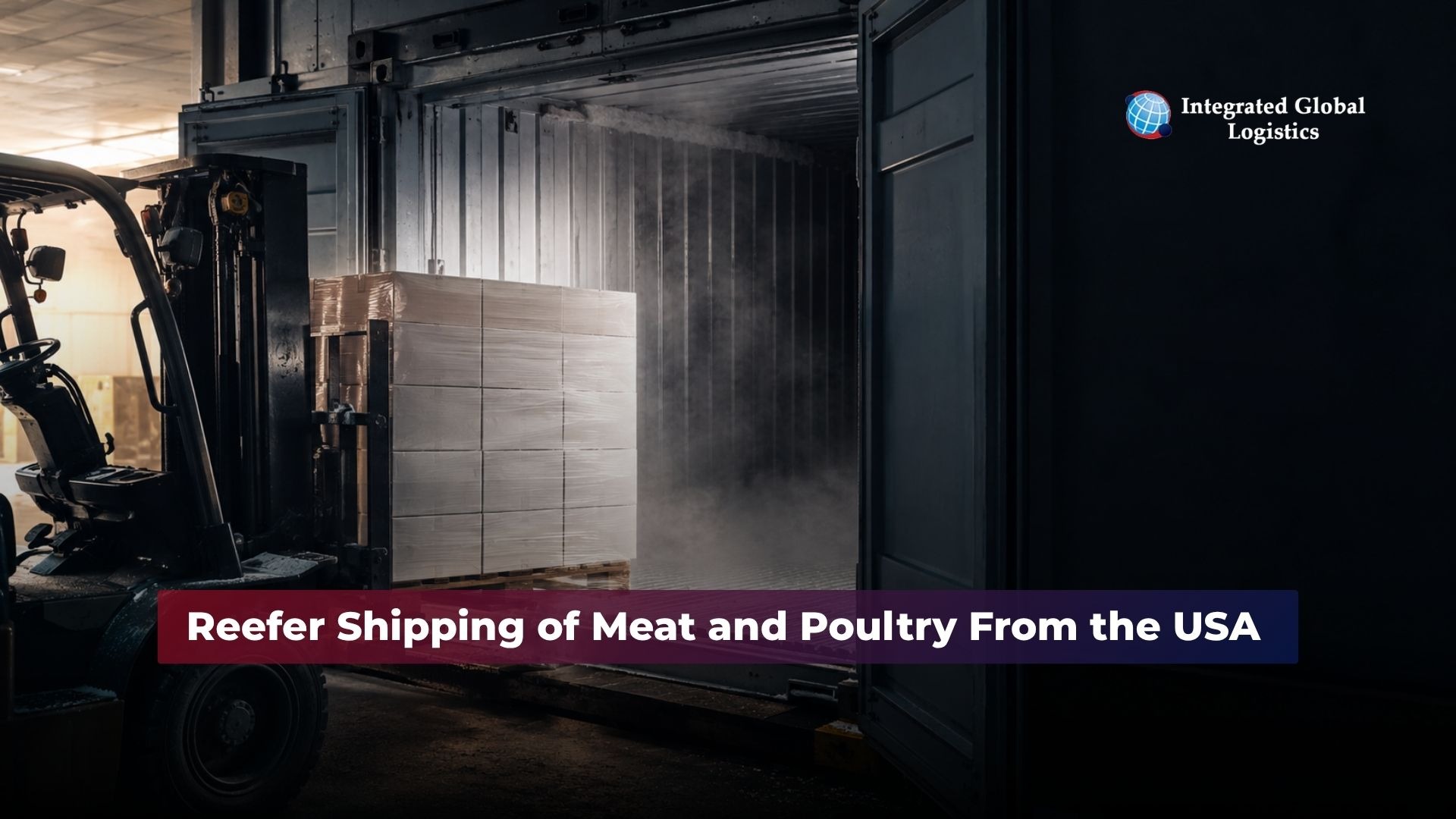
Reefer shipping of meat and poultry from the USA runs on two things: temperature and compliance. Frozen meat and poultry travel at a set point of -18 degrees Celsius, which is 0 degrees Fahrenheit, or colder, while chilled product is held just above freezing. Every export must come from a federally inspected establishment and carry the USDA FSIS export certificate, FSIS Form 9060-5. The cold chain has to hold from pre-cooling at the plant through loading, the ocean voyage, and delivery, which is why meat and poultry reward a specialist reefer partner.
Meat and poultry are among the most demanding cargo an exporter can ship. They are high in value, unforgiving of temperature error, and tightly regulated at both ends of the journey. A single break in the cold chain or a missing certificate can turn a full container into a total loss. Done properly, though, US meat and poultry move reliably to markets around the world, and the discipline behind it is well understood.
This guide covers what matters most on this lane: the set points for frozen and chilled product, the USDA export certification that makes a shipment legal, and the cold chain steps that keep the cargo saleable. It builds on the fundamentals of reefer container shipping and focuses them on the specific needs of meat and poultry exporters.
Why Meat and Poultry Demand Reefer Discipline
Unlike dry cargo, meat and poultry keep changing throughout the voyage. Temperature is the single variable that determines whether they arrive as premium product or as a claim. A rise of only a few degrees, held for only a few hours, can shorten shelf life, damage texture, or render a chilled shipment unsaleable. Because a reefer fault at sea cannot be repaired, the discipline has to be built in before the container ever leaves the plant.
On top of the physical demands sits a regulatory layer that dry cargo never faces. Meat and poultry are inspected, certified, and often subject to destination-specific eligibility rules. The exporters who move this cargo smoothly treat temperature control and compliance as one connected process, not two separate tasks, and they equip themselves with the right equipment and documentation from the start.
Reefer Set Points for Meat and Poultry
The correct set point depends on whether the product is frozen or chilled and on the importer's specification. The table below shows the typical ranges. The exact figure is always confirmed per shipment, because the destination country and the buyer can specify tighter tolerances.
| Product | Typical set point | Notes |
|---|---|---|
| Frozen beef and pork | -18°C (0°F) or colder | Deep-frozen product may go to about -25°C |
| Frozen poultry | -18°C (0°F) or colder | Held hard-frozen throughout the voyage |
| Chilled beef and pork | -1.5°C to 0°C | Just above freezing to maximize shelf life |
| Fresh poultry | -2°C to 2°C | Narrow window, very sensitive to handling |
Chilled product is the more difficult of the two, because the safe window is narrow and the margin for error is small. Getting it right depends on correct pre-cooling and equipment that holds temperature precisely, which is why the reefer container specifications and the condition of the unit matter as much as the number on the controller.
USDA and FSIS Export Compliance
US meat and poultry exports are regulated by the USDA's Food Safety and Inspection Service, or FSIS. The product must come from a federally inspected establishment, and each shipment carries the FSIS export certificate. The table below sets out the core requirements.
| Requirement | What it means |
|---|---|
| Federally inspected establishment | The product must be produced in a plant under FSIS federal inspection to be eligible for export. |
| FSIS Form 9060-6 | The application for the export certificate, submitted before certification. |
| FSIS Form 9060-5 | The Meat and Poultry Export Certificate of Wholesomeness, the core export document. |
| FSIS Export Library | Country-specific import requirements that must be checked for each destination. |
| PHIS | The Public Health Information System that processes applications and generates certificates. |
| Supplemental certificates | Extra attestations or letterhead certificates some countries require, sometimes with a veterinarian signature. |
Compliance does not end with temperature, and the paperwork has to be correct before the cargo sails. Handling the certification in step with the booking, rather than after, is a core part of temperature-controlled freight compliance and is where an experienced partner protects the shipment.
Exporting Meat or Poultry from the USA?
Integrated Global Logistics specializes in reefer ocean freight for frozen and chilled meat, poultry, and food-grade cargo, with USMEF and USAPEEC membership, a private reefer program, USDA export documentation support, and 99.5% on-time performance. Tell us your product, set point, and destination and our team will respond within one business day.
Request a Reefer QuoteThe Cold Chain from Plant to Port
The cold chain is only as strong as its weakest handoff. For meat and poultry, protecting it means controlling temperature at every point from the plant to the vessel, and treating each transfer as a moment of risk.
This discipline is the heart of cold chain logistics, and for meat and poultry it is non-negotiable. A partner with a dedicated reefer program manages these steps as routine rather than improvising them shipment by shipment.
Destination Requirements
Every importing country sets its own rules for US meat and poultry, and they are not optional. The FSIS Export Library lists the eligibility and certification requirements country by country, and they can include specific product statements, additional attestations, or a valid import permit held by the buyer. Some markets also require religious certification, such as halal, arranged through approved bodies.
Because these requirements change and vary by market, they are confirmed for each shipment against the destination and the importer before the cargo ships. Getting this wrong is one of the most common causes of a held or rejected consignment, so the destination check belongs at the start of the process, alongside the set point and the booking.
Choosing a Reefer Partner for Meat and Poultry
This cargo rewards specialists. The right partner brings equipment, food-grade experience, and documentation know-how together, so temperature and compliance are handled as one process. The traits that matter most are a dedicated reefer program with reliable equipment, genuine food-grade specialization, support with USDA export certification, and real experience on your destination markets.
Industry standing is a useful signal too. Membership in bodies such as the US Meat Export Federation and the USA Poultry and Egg Export Council reflects a focus on this exact cargo. When comparing providers, it helps to look at the established cold chain logistics companies that specialize in food exports rather than general forwarders that handle reefer occasionally.
Integrated Global Logistics LLC is an FMC licensed NVOCC and international freight forwarder, founded in 2015, specializing in refrigerated cargo for frozen and chilled meat, poultry, and food-grade exports. IGL holds USMEF and USAPEEC membership, runs a private reefer program, supports USDA export documentation, and delivers 99.5% on-time performance with one operations representative from start to finish, across 50+ countries worldwide.
Frequently Asked Questions
What temperature is used to ship frozen meat and poultry?
Frozen meat and poultry are typically shipped at a reefer set point of -18 degrees Celsius, which is 0 degrees Fahrenheit, or colder. Some deep-frozen products are carried down to around -25 degrees Celsius. The exact set point depends on the product, the importer's specification, and the destination country's requirements, so it is confirmed for each shipment rather than assumed.
What temperature is used for chilled or fresh meat?
Chilled or fresh meat is carried just above its freezing point to extend shelf life without freezing the product. Chilled beef and pork are usually held around -1.5 to 0 degrees Celsius, and fresh poultry is typically held around -2 to 2 degrees Celsius. Because the window is narrow, chilled meat depends heavily on accurate pre-cooling and continuous temperature control across the voyage.
What documents are needed to export meat and poultry from the USA?
US meat and poultry exports require the product to come from a federally inspected establishment and to be accompanied by the FSIS export certificate, applied for using FSIS Form 9060-6 and issued as FSIS Form 9060-5, the Meat and Poultry Export Certificate of Wholesomeness. Country-specific rules in the FSIS Export Library may add supplemental certificates or attestations. Standard shipping documents such as the commercial invoice, packing list, and bill of lading are also required.
What is the FSIS Export Certificate of Wholesomeness?
The FSIS Export Certificate of Wholesomeness, FSIS Form 9060-5, is the USDA certificate confirming that exported meat or poultry was produced under federal inspection and is wholesome and fit for human consumption. It is generated through the Public Health Information System, or PHIS, and for some destinations must be signed by a Public Health Veterinarian. It is the central export document for US meat and poultry.
What is a pre-trip inspection for a reefer?
A pre-trip inspection, or PTI, is a full check of a refrigerated container's cooling unit, airflow, seals, and controls before the container is released for loading. For meat and poultry, a passed PTI is essential because a reefer fault discovered at sea cannot be repaired, and a break in temperature can compromise an entire container of high-value cargo.
Does meat and poultry need to come from a USDA-inspected plant?
Yes. To be eligible for export, US meat and poultry must be produced in an establishment under FSIS federal inspection. The export certificate confirms this inspection. Destination countries may add their own eligibility rules on top, listed in the FSIS Export Library, so both the US inspection requirement and the importing country's requirements must be met.
How is the cold chain kept intact from plant to port?
The cold chain is kept intact by pre-cooling the cargo to its set point, loading into a reefer that has passed a pre-trip inspection, minimizing door-open time during loading, monitoring the temperature continuously with alerts, and ensuring the container is plugged in promptly at each transfer point. Each handoff between plant, truck, terminal, and vessel is a point where the temperature must be protected.
Why use a specialist reefer forwarder for meat and poultry?
Meat and poultry are high-value, perishable, and heavily regulated, so a specialist reefer forwarder reduces the risk of a costly loss. A specialist coordinates the pre-trip inspection, set point, monitoring, USDA export certification, and destination requirements as one process, and understands the documentation for each market. For food exporters, that experience is often the difference between cargo that arrives saleable and cargo that does not.
IGL Freight Intelligence
IGL's Freight Intelligence content is produced by IGL's operations and cold chain teams specializing in reefer ocean freight for frozen and chilled meat, poultry, and food-grade exports, USDA export documentation, and inland trucking across 50+ countries. (732) 250-9000 | info@integratedgl.com