
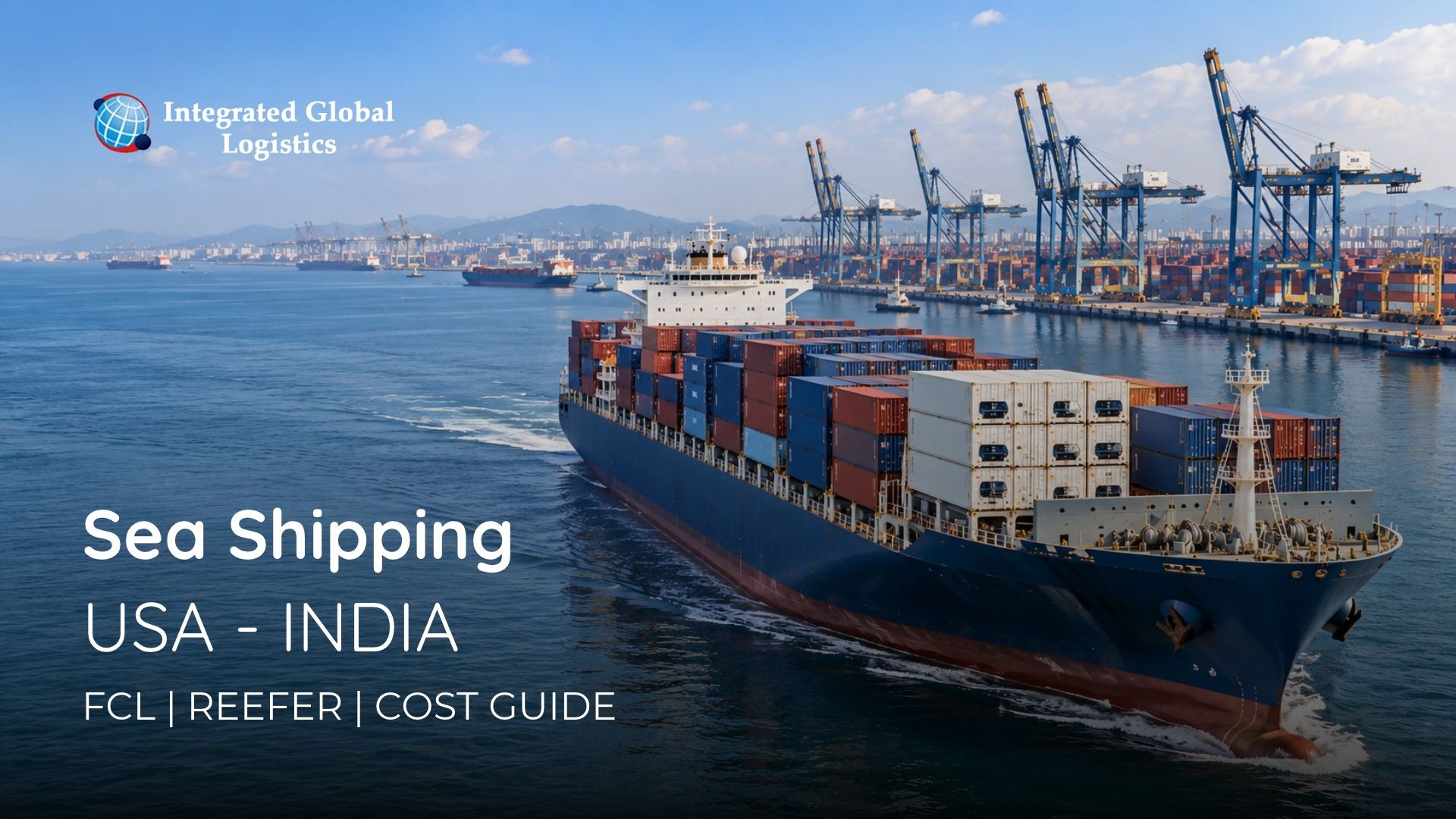
Sea shipping from the USA to India takes roughly 28 to 40 days port-to-port, depending on origin and routing. East Coast ports reach Nhava Sheva or Mundra via the Suez Canal in about 28 to 35 days, while West Coast origins run 32 to 40 days through a transshipment hub. Most cargo moves as FCL, with reefer for temperature-sensitive goods and LCL for small volumes. Imports clear through ICEGATE, require an Importer Exporter Code, and attract Basic Customs Duty and Integrated GST. The cost depends on the lane, container, volume, season, and surcharges.
India has become one of the most important markets in the world for US exporters, and the ocean lane between the two countries carries a rising share of that trade. Machinery, industrial equipment, food-grade commodities, chemicals, and consumer goods all move east across the water. The opportunity is clear, but so is the complexity: India is a long lane with a documentation regime that rewards preparation and punishes guesswork.
This guide answers the questions that decide a smooth shipment: how long the crossing takes, which container option fits your cargo, what the move will cost, and what Indian customs expects. It complements our detailed ocean freight to India lane overview with a sharper focus on the practical decisions you make before booking.
Why the USA to India Lane Is Growing
India is one of the largest and fastest expanding economies in the world, and its demand for imported machinery, technology, food-grade goods, and industrial inputs has made it a priority market for US exporters. Ocean freight carries the heavy, high-volume cargo that air cannot economically move, which is why sea shipping sits at the center of the trade relationship.
The lane also rewards planning because India is not a single-port market. Cargo for the west and north often routes through Nhava Sheva or Mundra, shipments for the south favor Chennai, and eastern destinations use Kolkata. The most efficient path depends on the final delivery point inside India, so port selection is a real decision rather than a default.
Transit Times by Port
Transit depends on the origin port and the routing. The figures below are typical port-to-port ocean estimates. East Coast cargo generally routes through the Mediterranean and the Suez Canal, while West Coast cargo crosses the Pacific and transships through a hub such as Colombo or Singapore. Routing and transit shift with global conditions, so treat these as planning ranges, and note they exclude inland transport and Indian customs clearance.
| US Origin | Indian Destination | Port-to-Port |
|---|---|---|
| New York / New Jersey | Nhava Sheva | 28 to 35 days |
| Savannah | Mundra | 28 to 35 days |
| Houston | Mundra / Nhava Sheva | 30 to 38 days |
| Los Angeles / Long Beach | Nhava Sheva | 32 to 40 days |
| New York / New Jersey | Chennai | 30 to 38 days |
Direct services shorten transit and reduce handling risk, while transshipment routings add days at the hub. For time-sensitive cargo it is worth confirming whether a service is direct or transships, and building buffer time into delivery commitments accordingly.
FCL, Reefer, or LCL
The container decision is the first one to make, and it turns mostly on volume and whether the cargo needs temperature control.
FCL for most shipments
Most US exports to India travel as full container load dry cargo: machinery, industrial equipment, textiles, chemicals, and general merchandise in a dedicated sealed container. FCL gives full control from origin to destination and reduces handling on a long voyage, which lowers the risk of damage.
Reefer for temperature-sensitive cargo
Food-grade and other temperature-sensitive exports move in refrigerated containers that hold a programmed set point across the voyage. Because the India lane is long, the discipline behind reefer container shipping matters even more than usual, from pre-cooling to continuous monitoring.
LCL for smaller volumes
Shipments too small to fill a container move as less than container load, sharing space with other cargo and paying only for what they use. LCL involves more handling, so clear labeling and solid packaging matter, but it opens the lane to smaller consignments.
Shipping from the USA to India?
Integrated Global Logistics is an FMC licensed NVOCC moving FCL, reefer, and dry cargo to India, with in-house customs and documentation, multiple carrier options, and 99.5% on-time performance. Tell us your origin, destination port, and cargo and our team will respond within one business day.
Get a USA to India Shipping QuoteWhat Drives the Cost
There is no single price for shipping a container from the USA to India, because ocean freight moves with the market and with the specifics of each shipment. What can be explained is what the cost is made of, so you can read a quote and compare it fairly. The main drivers are the origin and destination ports, the container type and whether the move is FCL or LCL, the cargo weight and volume, the season and current carrier capacity, surcharges such as the fuel adjustment and terminal handling, and any inland transport at either end.
Reefer cargo carries a premium over dry because the equipment is powered and monitored. Because all of these move together, a general figure rarely matches a real shipment, and the most reliable number comes from a quote specific to your cargo. The same way of reading a container shipping cost applies directly to the India lane.
Indian Customs and Documentation
India's import process is where many shipments lose time, and it is the part of the lane that most rewards experience. The Indian importer of record must hold an Importer Exporter Code, or IEC, issued by the Directorate General of Foreign Trade, before any goods can be cleared, so this belongs at the start of the process.
Standard shipments require a commercial invoice, a packing list, and a bill of lading, with details that match across all three. The Bill of Entry is filed electronically through ICEGATE, the Indian Customs Electronic Data Interchange Gateway, and duties including Basic Customs Duty and Integrated GST are assessed by HS code. Certain products, many electronics among them, require BIS registration before they can enter, and food and agricultural cargo requires the relevant sanitary clearances. On the US side, an Electronic Export Information filing is generally required for qualifying shipments. Handling these in parallel with the booking, rather than after cargo is on the water, is what keeps a container from stalling at the border.
Choosing a Partner for the Lane
The India lane ties together carrier space, a long ocean routing, a demanding customs regime, and inland legs at both ends. A partner who manages all of it as one process removes the gaps where cost and delay usually appear. The traits that matter most are FMC licensing, direct carrier contracts for reliable space, in-house customs and documentation to handle the Indian requirements cleanly, reefer capability for food-grade cargo, and a single accountable contact from booking to delivery.
When you are ready to move, knowing how to request an ocean freight quote with complete details is the fastest way to get an accurate number and compare options on the same basis.
Integrated Global Logistics LLC is an FMC licensed NVOCC and international freight forwarder, founded in 2015, with more than 10 years of experience, thousands of TEUs managed annually, and 99.5% on-time performance. IGL moves FCL, reefer, and dry cargo on the USA to India lane with direct carrier contracts, in-house customs and documentation, real-time visibility, and one operations representative from start to finish, with coverage to 50+ countries worldwide.
Frequently Asked Questions
How long does sea shipping from the USA to India take?
Port-to-port ocean transit from the USA to India typically runs about 28 to 40 days depending on the origin and routing. US East Coast ports to Nhava Sheva or Mundra run roughly 28 to 35 days via the Suez Canal, while US West Coast origins run about 32 to 40 days, usually transshipping through a hub such as Colombo or Singapore. Door-to-door timelines are longer once inland transport, export handling, and Indian customs clearance are added.
What are the main Indian ports for shipping from the USA?
The main Indian gateways are Nhava Sheva, also called Jawaharlal Nehru Port, which is India's largest container port near Mumbai, and Mundra in Gujarat, a large and efficient privately operated port. Chennai serves South India and Kolkata serves the east. Selecting the destination port closest to the final delivery point usually saves more time and cost than shaving days off the ocean leg.
How much does it cost to ship a container from the USA to India?
There is no fixed price. The cost of sea shipping from the USA to India is shaped by the origin and destination ports, the container type and whether the shipment is FCL or LCL, the cargo weight and volume, the season and carrier capacity, surcharges such as fuel and terminal handling, and any inland transport. Because these factors move with the market, an accurate cost comes from a quote specific to your shipment rather than a published figure.
Can I ship reefer cargo from the USA to India?
Yes. Refrigerated containers carry temperature-sensitive US exports such as food-grade commodities to India, holding a programmed set point across the voyage. Because the lane is long, reefer shipments depend on correct pre-cooling, a passed pre-trip inspection, continuous monitoring, and prompt plug-in at each port. Food and agricultural imports also require the relevant Indian sanitary and food safety clearances.
What documents are needed to ship from the USA to India?
Indian imports require a commercial invoice, packing list, and bill of lading, and the Indian importer must hold an Importer Exporter Code, or IEC, issued by the DGFT. The Bill of Entry is filed electronically through ICEGATE, and duties including Basic Customs Duty and Integrated GST apply. Certain products, such as many electronics, require BIS registration before they can be cleared. On the US side, an Electronic Export Information filing is generally required for qualifying shipments.
Which US ports ship to India?
US East Coast ports such as New York and New Jersey, Savannah, and Norfolk offer the shortest routing to India via the Suez Canal. Gulf ports such as Houston and West Coast ports such as Los Angeles, Long Beach, and Oakland also serve the lane, usually with transshipment and longer transit. Cargo from inland regions reaches these gateways by truck or rail before loading.
Is FCL or LCL better for shipping to India?
It depends on volume. FCL, or full container load, gives a dedicated container and suits larger shipments, offering more control and less handling on a long lane. LCL, or less than container load, shares a container and suits smaller volumes, charging only for the space used. Most India shipments of moderate to large volume move as FCL, while small consignments favor LCL.
Do I need a freight forwarder to ship from the USA to India?
A forwarder is not legally required, but the India lane is document-heavy and rewards experience. A forwarder or NVOCC books carrier space, prepares export documentation, coordinates inland transport, and manages the Indian customs requirements including ICEGATE filing and product registrations. On a lane where a missing registration or an incorrect classification can hold a container, an experienced partner is usually the difference between a smooth move and a costly one.
IGL Freight Intelligence
IGL's Freight Intelligence content is produced by IGL's operations and ocean freight teams specializing in FCL, reefer, and dry cargo ocean freight, transpacific and Suez trade lanes, and inland trucking across 50+ countries. (732) 250-9000 | info@integratedgl.com